- HOME
- Sustainability
- Materiality and KPIs
- Small
- Large
Materiality and KPIs
The LINTEC Group identifies priority issues to be addressed in order to contribute to the realization of a sustainable world as materiality, and has also established key performance indicators (KPIs)* to check the progress of its efforts.
- * Key performance indicators (KPIs): KPIs are important indicators related to organizational strategies, and quantitatively measure progress toward targets.
- Note: Go to the Investor Relations page.
"LSV 2030 - Stage 2"
Materiality and KPIs were revised to align with the new medium-term management plan, “LSV 2030 - Stage 2.” To finalize the recent revision, we applied the concept of double materiality*.
In addition, the CO2 emissions reduction targets aimed at realizing a carbon-free world were revised as the previous target of a 50% or more reduction by 2030 compared to FY2013 levels was achieved ahead of schedule as a result of the intense acceleration of the implementation of measures. The revised targets are 67% or more set for Stage 2 and 75% or more for Stage 3.
- *Double materiality: The identification of material issues related to sustainability using different criteria for assessing two types of impact: impact of business on society and the environment; and financial impact of sustainability issues
LINTEC’s Materiality
Our finalized materiality is as follows:
Work to solve social issues through business activities
Foster innovation to build a robust corporate structure and drive sustainable growth
Fulfill responsibilities associated with the environment, society, and customers
Develop and secure human resources for the future
Maintain LINTEC’s favorable reputation
Materiality Identification Process
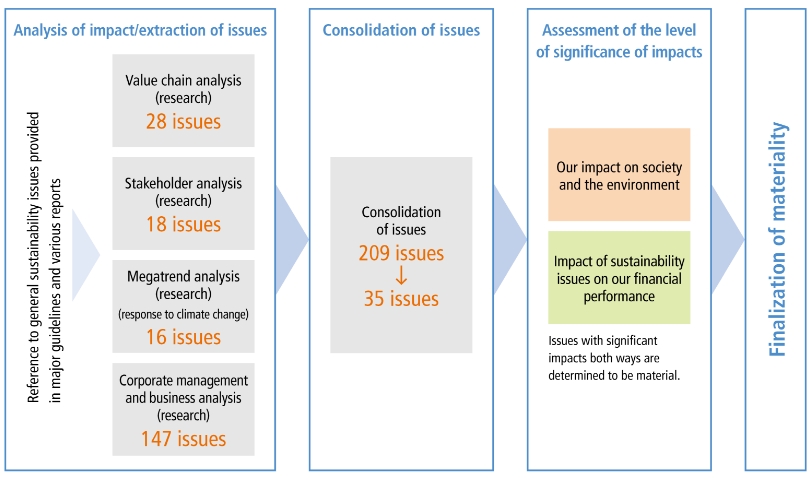
We have identified our materiality by following a four-step process: (1) analysis of impact of and extraction of sustainability issues; (2) consolidation; (3) assessment of the level of significance of impacts (our impact on society and the environment, and impact of sustainability issues on our financial performance); (4) identification and finalization of materiality.
(1) Analysis of impact of and extraction of sustainability issues
In the first step of the process, four different analyses (value chain analysis, stakeholder analysis, megatrend analysis, and corporate management and business analysis) were performed to assess impacts of sustainability issues. As a result, 209 issues representing a wide range of perspectives were extracted.
(2) Consolidation
Since the issues were extracted through four different analyses conducted separately, some of them overlapped or were largely the same. We therefore consolidated the 209 identified issues into 35 distinct issues.
Scroll the table sideways to view.
| Value chain analysis | Analysis performed to assess our sustainability impact at each level of the value chain from raw material procurement to sale, use, and disposal/recycling of products in each business segment with the aim of extracting key issues |
|---|---|
| Stakeholder analysis | Analysis of our employees, customers, business partners, and shareholders and investors, as well as of society and the economy, to identify stakeholder interests, problems, and expectations with the aim of extracting key issues |
| Megatrend analysis | Analysis of climate change, loss of natural ecosystems, demographic and age composition, resources and energy, technology, and other trends to examine their changes and impacts on our business with the aim of extracting issues that need to be addressed to fulfill the group’s social role |
| Corporate management and business analysis | Analysis of our Corporate Motto and Mission Statement, messages from the President, code of conduct, various policies, LSV 2030, presentation aterials from financial results briefings, and other corporate management information with the aim of extracting existing and possible future issues |
(3) Assessment of the level of significance of impacts (our impact on society and the environment, and impact of sustainability issues on our financial performance)
Prior to finalizing our materiality, for each of the 35 consolidated issues we assessed the significance of both our impact on society and the environment and the impact of each issue on our own financial performance.
For our impact on society and the environment, we examined the magnitude of the impact and the likelihood of occurrence of each issue to determine the significance. For the impact of the issues on our financial performance, we assessed the level of significance by examining risks (impact on our financial performance that may occur if we fail to address the issue) and business opportunities (benefit for our revenue development that we may gain by addressing the issue).
(4) Identification and finalization of materiality
After identifying sustainability issues with significant impacts on society and the environment as well as on our own financial performance, we further consolidated related issues and finalized our materiality, which comprises five key issues.
Establishment of Key Performance Indicators (KPIs)
We have established key performance indicators (KPIs) for the finalized materiality to keep track of the progress of planned measures. The KPIs are aligned with initiatives taken by each department and are based on effective measures for achieving the materiality.